

Magnesium gets recommended for everything.
Can’t sleep? Magnesium. Stressed? Magnesium. Muscle spasms? Magnesium. Existential crisis… probably Mg, according to the internet.
As a cardiac nurse, magnesium lives in a very different realm for me. In the hospital, it’s not just some trendy supplement – It’s a clinically important electrolyte that we take pretty seriously, especially when it comes to your ticker.
So when I kept seeing Magnesium marketed as a cure-all online, I got curious.
This post is my attempt to separate:
- What magnesium actually does
- What the evidence supports
- and what’s… just really great marketing
Why Magnesium Matters
In cardiac care, magnesium is not just some decorative or optional grab-off-the-shelf.
It plays a key role in:
- Heart rhythm stability
- Neuromuscular signaling
- Electrolyte balance, especially its relationship with potassium and calcium (I won’t bore you with protein pumps).
- Energy production at the cellular level
Low Mg levels can contribute to arrhythmias, muscle irritability, weakness, and overall systemic chaos – which is why we monitor and replace it carefully in clinical settings.
That being said, the fact that magnesium is important does not mean taking MORE of it automatically makes you healthier. (More ≠ better. This will come up again.)
The Main Forms of Magnesium (What They’re Actually Used For)
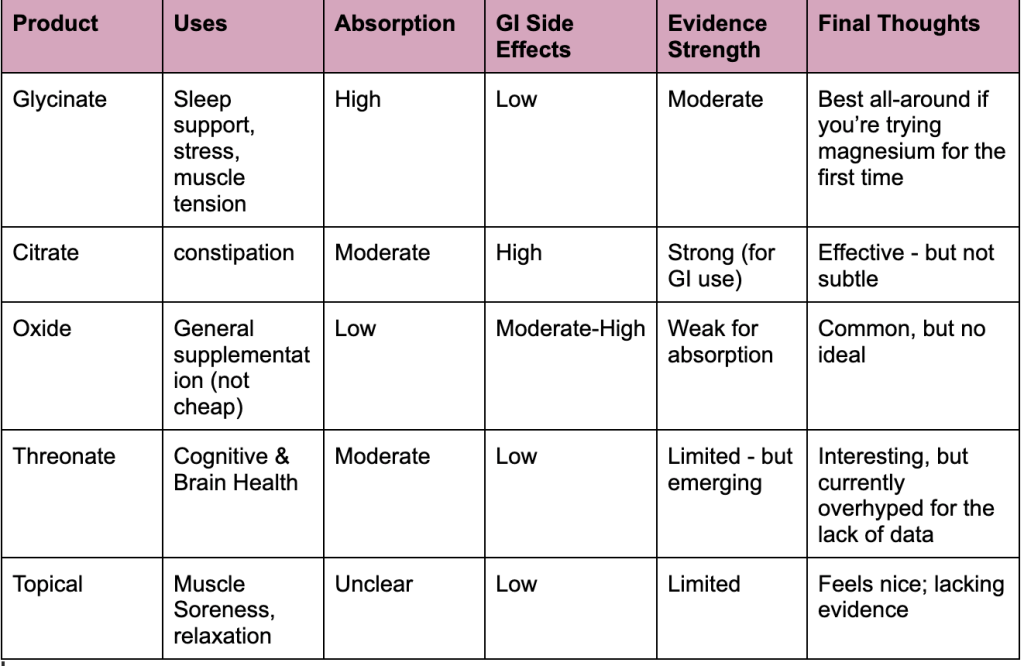
Magnesium Glycinate
This is the form you’ll usually see recommended for sleep or stress
WHY?
- It’s bound to glycine (an amino acid with calming properties)
- Generally well absorbed
- Less likely to cause GI chaos
Evidence-Based Takeaway:
May be helpful for mild sleep issues, muscle tension, or low Mg intake.
Reality Check:
It won’t knock you out like a sleep med. If it does, something else is going on in that body of yours.
Magnesium Citrate
This one is… memorable
- Pulls water into the intestines
- Popular constipation remedy (very effective in doing exactly that)
Evidence-Based Takeaway:
Helpful for constipation. Not ideal if your main goal is relaxation or sleep – unless your idea of chillin’ out involves sprinting to the bathroom.
Magnesium Oxide
It’s legit everywhere – and usually is the cheapest option.
- Poor absorption
- Higher likelihood of GI side effects
- Still used clinically for specific purposes
Bottom Line:
Not my personal first choice for general supplementation. Simply based on the evidence.
Magnesium Threonate
Often marketed as “brain fuel.”
- Can cross the blood-brain barrier
- Some early, but very interesting research
- A LOT of very confident and reputable claims online
Evidence-Based Takeaway
Promising, but not currently more “hype” than hard conclusions. Basically, it is still early in the research realm for valid proof of its outcomes.
Topical Magnesium (Sprays, Lotions, Baths)
VERY popular (my husband loves his Mg Baths). VERY debated topic online.
- Absorption through skin is not well established/understood
- Limited high-quality data
Honest Take:
It might feel nice. Whether it actually changes Mg levels is unclear. Basically hard to tell if its “placebo” since they don’t yet truly understand its mechanism in the body.
What Magnesium Can Help With
Mg supplements may be helpful for:
- People with low dietary intake
- Certain muscle cramps or tension
- Mild sleep disturbances
- Specific cardiac or metabolic issues (under medical guidance)
It is not:
- A cure for anxiety
- A sleep remedy
- A fix for chronic exhaustion
- A personality trait
A Quick (But Important) Safety Moment
This is the part wellness content loves to skip.
Magnesium supplements can cause:
- Diarrhea
- Abdominal cramping
- Electrolyte imbalances at high doses
If you have kidney disease, are on certain medications, or have cardiac conditions, magnesium supplementation is not something to start without medical guidance from a primary care provider.
How I Think About Magnesium (Clinically & Personally)
Instead of asking “which magnesium should I take”
Ask “do I actually need magnesium – and if so, for what reason?”
Table – Magnesium Forms Compared
Need Some Magnesium? Here’s the Final Verdict.
💤 Magnesium Glycinate
“The calm-but-not-comatose option”
For when you want your nervous system to take a deep breath — not pass out dramatically. Often used for sleep support, stress, and muscle tension, without the GI chaos.
👉 Link to magnesium glycinate here
🚽 Magnesium Citrate
“Trouble on the throne”
Effective. Efficient. Not subtle. If your goal is constipation relief, magnesium citrate absolutely understands the assignment. If your goal is sleep… maybe reconsider.
👉 Link to magnesium citrate here
💸 Magnesium Oxide
“The budget-friendly disappointment”
Widely available, inexpensive, and unfortunately not very well absorbed. It shows up in a lot of supplements — but that doesn’t make it the best choice.
👉 Link to magnesium oxide here
🧠 Magnesium Threonate
“The ‘big brain’ magnesium”
Marketed for cognitive health and brain support. Promising research, lots of hype, and still more questions than answers. Interesting — just not magic.
👉 Link to magnesium threonate here
🧴 Topical Magnesium (Sprays / Lotions)
“Feels productive, results unclear”
Relaxing? Yes. Proven to significantly raise magnesium levels? Jury’s still out. A vibes-based supplement experience.
👉 Link to magnesium cream here
👉 Link to magnesium spray here
👉 Link to magnesium bath salts here
References
- Arab, A., Rafie, N., Amani, R., & Shirani, F. (2023). The role of magnesium in sleep health: a systematic review of available literature. Biological trace element research, 201(1), 121-128.
- Adkhamova, S. A. (2026). THE EFFECT OF NUTRITIONAL SUPPORT WITH MAGNESIUM L-THREONATE ON COGNITIVE PERFORMANCE AND ACADEMIC ACHIEVEMENT IN STUDENTS. AMERICAN JOURNAL OF APPLIED MEDICAL SCIENCE, 4(2), 26-29.
- Bassotti, G., Villanacci, V., & Corsetti, M. (2023). Exploring pharmacological treatments for chronic idiopathic constipation in adults: a look back to the future. Journal of Clinical Medicine, 12(4), 1702.
- Mathew, A. A., & Panonnummal, R. (2023). A mini review on the various facets effecting brain delivery of magnesium and its role in neurological disorders. Biological Trace Element Research, 201(9), 4238-4253.
- Reno, A. M., Green, M., Killen, L. G., O’Neal, E. K., Pritchett, K., & Hanson, Z. (2022). Effects of magnesium supplementation on muscle soreness and performance. The Journal of Strength & Conditioning Research, 36(8), 2198-2203.
- Tarsitano, M. G., Quinzi, F., Folino, K., Greco, F., Oranges, F. P., Cerulli, C., & Emerenziani, G. P. (2024). Effects of magnesium supplementation on muscle soreness in different type of physical activities: a systematic review. Journal of translational medicine, 22(1), 629.
- Varvara, R. A., & Vodnar, D. C. (2024). Probiotic-driven advancement: Exploring the intricacies of mineral absorption in the human body. Food Chemistry: X, 21, 101067.
- Veronese, N., Pizzol, D., Smith, L., Dominguez, L. J., & Barbagallo, M. (2022). Effect of magnesium supplementation on inflammatory parameters: a meta-analysis of randomized controlled trials. Nutrients, 14(3), 679.
- Zhang, C., Hu, Q., Li, S., Dai, F., Qian, W., Hewlings, S., … & Wang, Y. (2022). A Magtein®, Magnesium L-threonate,-based formula improves brain cognitive functions in healthy Chinese adults. Nutrients, 14(24), 5235.
 The Evidence EdIT
Leave a comment